Register today
About the Presentation
Justice Amy Coney Barrett has said the Declaration of Independence is “not law,” and Justice Antonin Scalia expressed a similar view.
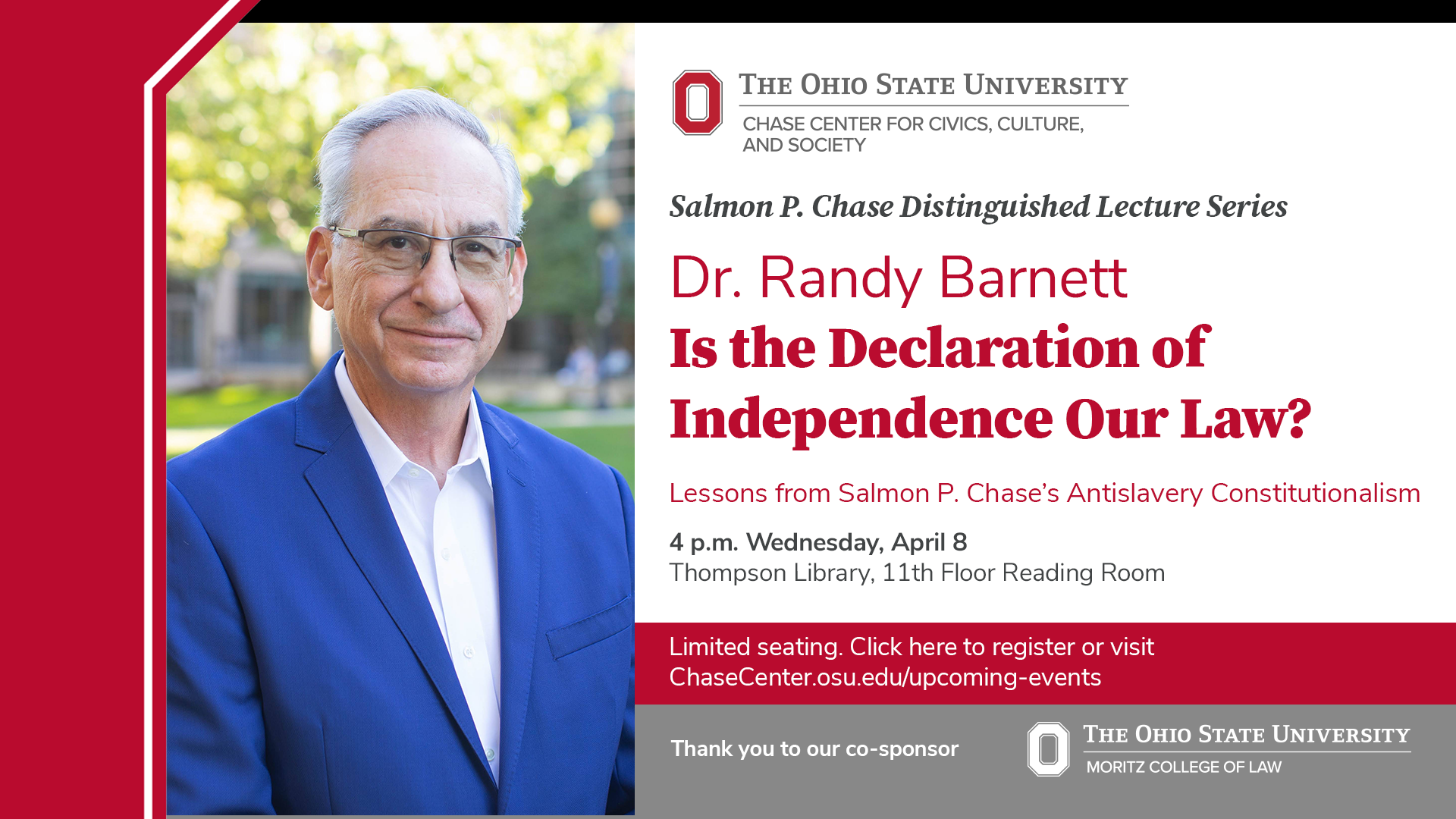
Randy E. Barnett argues that the Declaration is part of our law in a foundational sense—an authoritative public act that announced the American theory of legitimate government, fixed the ends of political authority, and continues to supply legally relevant reasons for officials, even if it does not create a standalone cause of action.
To illustrate this tradition in action, the lecture highlights how Chief Justice Salmon P. Chase invoked the Declaration as a young lawyer defending fugitive slaves in Ohio and later as the U.S. Senator from Ohio—representative of the Declaration's widespread use by antislavery constitutionalists.
About Randy Barnett
Randy E. Barnett is author of 14 books, including his memoir, A Life for Liberty: The Making of an American Originalist. He is the Patrick Hotung Professor of Constitutional Law at the Georgetown University Law Center, where he is Faculty Director of the Georgetown Center for the Constitution.
In 2004, he argued the medical marijuana case of Gonzeles v. Raich in the U.S. Supreme Court. In 2012 he represented the National Federation of Independent Business in its Challenge to Obamacare.
A recipient of a Guggenheim Fellowship in Constitutional Studies and the Bradley Prize, he divides his time between Central Virginia and Sarasota, Florida. His most recent book is Felony Review: Tales of True Crime and Corruption in Chicago, decribing the lessons he learned as a criminal prosecutor in Chicago.
In 2010, Professor Barnett portrayed a prosecutor in the sc-fi feature film Inalienable (which can be viewed for free on YouTube).