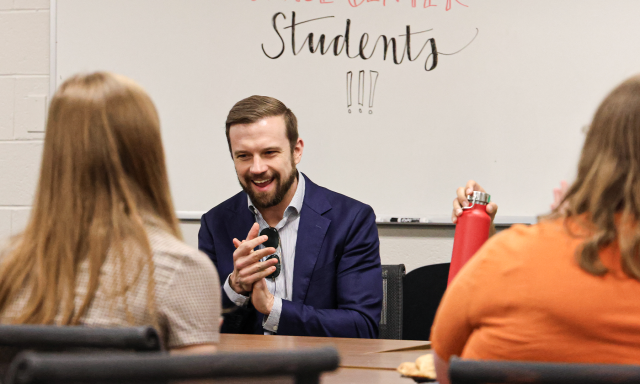
The Chase Center prioritizes active student participation through seminar-style courses that encourage students to engage in deliberative, civil, and constructive dialogue.
Students will sharpen their logical and analytical reasoning, as well as develop strong written and verbal communication skills. They are encouraged to share their views and expected to respectfully engage opposing perspectives in the collective pursuit of deeper knowledge and shared understanding.
Where to start?
Have questions? Feel free to schedule a meeting with an advisor. They are happy to help!
Courses Fulfilling the Civic Literacy Requirement
In Ohio, students attending The Ohio State University and other state institutions of higher education must complete at least one three-hour course in the subject of American civic literacy. This requirement is effective for incoming students as of Fall 2026.
These courses include the entire Constitution of the United States; the entire Declaration of Independence; a minimum of five essays in their entirety from the Federalist Papers; the entire Emancipation Proclamation; the entire Gettysburg Address; the entire Letter from Birmingham Jail written by Dr. Martin Luther King Jr; and the writings of Adam Smith, including a study of the principles written in The Wealth of Nations.
The following courses offered by the Salmon P. Chase Center fulfill this requirement, as well as the GE Foundation credits for Social and Behavioral Sciences.
The American Experiment (CIVICLL 2110) | 3 Credit Hours | Civic Literacy; GEN Foundation: Social and Behavioral Sciences
- Sections:
- 10 (34836) John Thrasher, Catherine Lemos, Albert Cheng, TuTh 9:35-10:55am
- 30 (35074) TBA, TuTh 12:45-2:05pm
- 40 (35075) Jesse Smith, WeFr 9:35-10:55am
- 60 (35077) Alex Lovelace, WeFr 12:45-2:05pm
- 80 (35530) Wes Siscoe, Online, asynchronous
What makes America work? How do our own decisions make the nation better or worse? This civic literacy course compares answers to these questions from political leaders, constitutional theorists, and social scientists.
American Civic Traditions (CIVICLL 2120) | 3 Credit Hours | Civic Literacy (Beginning SP27); GEN Foundation: Historical and Cultural Studies
- Sections:
- 20 (31071) Paul Wilford and James Wilson, TuTh 11:10am-12:30pm
- 30 (31072) Daniel Gullotta, TuTh 9:35-10:55am
- 40 (31077) David Little, TuTh 11:10am-12:30pm
- 60 (35079) Alex Lovelace, WeFr 9:35-10:55am
- 70 (35080) Heather Wilford, WeFr 11:10am-12:30pm
- 80 (35081) Matthew Frakes, WeFr 12:45-2:05pm
- 90 (35082) Heather Wilford, WeFr 2:20-3:40pm
- 110 (35531) David Upham, MoWe 9:35-10:55am
- 130 (36348) Alex Lovelace, Online, asynchronous
- 140 (36521) Ivan Kurilla, TuTh 11:10am-12:30pm
- 150 (36522) Sabrina Little, WeFr 11:10am-12:30pm
- 160 (36523) Ivan Kurilla, TuTh 2:20-3:40pm
Is America exceptional? What are the sources of American identity, and what are the conflicts that have changed the nation? This course considers competing cultural sources for the strengths of American democracy.
Spring 2027 Courses
Can We Rule Ourselves? (CIVICLL 2000) | 3 Credit Hours | GEN Theme: Citizenship for a Diverse and Just World | CIVICLL Major: Core Course
- Sections:
- 20 (35527) Wan Ning Seah, TuTh 2:20-3:40pm
- 30 (35528) Jacob Hall, WeFr 9:35-10:55am
- 40 (36714) Paul Wilford, TuTh 3:55-5:15pm
The United States is supposed to be a self-governing republic. But most attempts at self-government in history have failed. This course surveys the origins, institutions, achievements and failures of past efforts at self-government, so that we can better understand the challenges Americans face today.
The American Experiment (CIVICLL 2110 ) | 3 Credit Hours | Civic Literacy; GEN Foundation: Social and Behavioral Sciences
- Sections:
- 10 (34836) John Thrasher, Catherine Lemos, Albert Cheng, TuTh 9:35-10:55am
- 30 (35074) TBA, TuTh 12:45-2:05pm
- 40 (35075) Jesse Smith, WeFr 9:35-10:55am
- 60 (35077) Alex Lovelace, WeFr 12:45-2:05pm
- 80 (35530) Wes Siscoe, Online, asynchronous
What makes America work? How do our own decisions make the nation better or worse? This civic literacy course compares answers to these questions from political leaders, constitutional theorists, and social scientists.
American Civic Traditions (CIVICLL 2120) | 3 Credit Hours | Civic Literacy (Beginning SP27); GEN Foundation: Historical and Cultural Studies
- Sections:
- 20 (31071) Paul Wilford and James Wilson, TuTh 11:10am-12:30pm
- 30 (31072) Daniel Gullotta, TuTh 9:35-10:55am
- 40 (31077) David Little, TuTh 11:10am-12:30pm
- 60 (35079) Alex Lovelace, WeFr 9:35-10:55am
- 70 (35080) Heather Wilford, WeFr 11:10am-12:30pm
- 80 (35081) Matthew Frakes, WeFr 12:45-2:05pm
- 90 (35082) Heather Wilford, WeFr 2:20-3:40pm
- 110 (35531) David Upham, MoWe 9:35-10:55am
- 130 (36348) Alex Lovelace, Online, asynchronous
- 140 (36521) Ivan Kurilla, TuTh 11:10am-12:30pm
- 150 (36522) Sabrina Little, WeFr 11:10am-12:30pm
- 160 (36523) Ivan Kurilla, TuTh 2:20-3:40pm
Is America exceptional? What are the sources of American identity, and what are the conflicts that have changed the nation? This course considers competing cultural sources for the strengths of American democracy.
America’s Foundational Debates (CIVICLL 2130) | 3 Credit Hours | GEN Theme: Citizenship for a Diverse and Just World | CIVICLL Major Category: Core Course
- Sections:
- 20 (35532) Jeremy Fortier, WeFr 11:10-12:30pm
- 30 (35533) David Little, TuTh 2:20-3:40pm
- 40 (36346) Christopher Green, TuTh 11:10am-12:30pm
Explore big debates in American constitutionalism: should the constitution be amended? How does America's constitutional tradition compare with alternatives from across history and around the world? What constitutional standards should influence college admissions policies?
Freedom and Equality in American Literature (CIVICLL 2210) | 3 Credit Hours | GEN Theme: Citizenship for a Diverse and Just World | Embedded Honors section available | CIVICLL Major Category: American Civic Life
- Sections:
- 10 (36528) Michael Clune, MoWe 2:20-3:40pm
What is the relationship between politics and literature? How does creative writing contribute to citizenship? How have American novels examined American ideals? Answer these questions with a distinguished literary scholar and novelist.
The Evolution of Citizenship in America, 1775-1920 (CIVICLL 2420) | 3 Credit Hours | GEN Theme: Citizenship for a Diverse and Just World | CIVICLL Major Category: American Constitutionalism
- Sections:
- 10 (35083) Brianna Frakes, TuTh 2:20-3:40pm
- 20 (36524) Brianna Frakes, TuTh 11:10am-12:30pm
Who counts as an American citizen? How has the answer changed over American history? Who has been responsible for changing it? Learn how American citizenship has changed due to people working within the legal system, and outside of it.
From Data to Decisions: When Numbers Can (and Can’t) Solve Policy Problems (CIVICLL 2500) | 3 Credit Hours | CIVICLL Major Category: American Leadership
- Section 10 (36519) Albert Cheng, TuTh 2:20-3:40pm
Did that policy work? What would it be like if another policy was tried? How can data help answer these questions? This course explores the value and the limits of quantitative social science: using data to understand and fix public policy problems, in fields including education, health, law, economics, and public safety.
Directed Readings in Civics, Law, and Leadership (CIVICLL 3193) | 1 Credit Hour | CIVICLL Major Category: Elective
These small-group discussions are led by Chase Center faculty and provide an excellent opportunity to engage with important texts and ideas while getting to know professors in a more personal and informal setting outside the classroom. Reading groups typically meet regularly throughout the semester and are designed to foster thoughtful conversation and intellectual community.
Christianity, Government, and Law (CIVICLL 3212) | 3 Credit Hours | GEN Theme: Citizenship for a Diverse and Just World | Embedded Honors section available | CIVICLL Major Category: American Civic Life
- Sections:
- 10 (35536) James Hooks, TuTh 12:45-2:05pm
- 20 (36520) William Simpson, TuTh 9:35-10:55am
How has Christianity transformed politics and law? How have politics and law changed Christianity? This course explores the relationship between religion and politics from the Roman era to contemporary America.
How Politics Breaks Your Brain (CIVICLL 3300) | 3 Credit Hours | GEN Theme: Citizenship for a Diverse and Just World | Embedded Honors section available | CIVICLL Major Category: American Civic Life
- Sections:
- 10 (35084) Frank Ngo and Laura Siscoe, TuTh 12:45-2:05pm
Does politics make people smarter or dumber? Is there a way to stop politics from making people stupid? Take this course to find out.
Knowledge for Citizenship: Seeking Shared Truth in a Divided Society (CIVICLL 3305) | 3 Credit Hours | GEN Theme: Citizenship for a Diverse and Just World | CIVICLL Major Category: American Civic Life
- Section 10 (35537) Jesse Smith, WeFr 12:45-2:05pm
What media sources should you trust? Should we defer to experts or rely on our independent judgments? Is it possible to find shared truth in a polarized society?
Toleration and Its Discontents (CIVICLL 3320) | GEN Theme: Traditions, Cultures, Transformations | CIVICLL Major Category: American Civic Life
- Section 10 (37266), TuTh 12:45pm-2:05pm
What are the institutions, laws, and practices that make for a tolerant society? How have they developed, and why have they been criticized? Explore these questions through politics, philosophy, economics, and literature.
Technology and American Democracy: An Inquiry Through History and Law (CIVICLL 3480) | 3 Credit Hours | GEN Theme: Traditions, Cultures, and Transformations | CIVICLL Major Category: American Constitutionalism
- Section 10 (37267) Jacob Bruggeman, TuTh 11:10am-12:30pm
Technology built the United States. Will it destroy us? In this course you will study how technology has transformed American democracy, and how law has been used to regulate technology.
Presidential Crises in War and Peace (CIVICLL 3550) | 3 Credit Hours | CIVICLL Major Category: American Leadership
- Section 10 (35540) Matthew Frakes, WeFr 9:35-10:55am
How do you make decisions under pressure? What qualities do leaders need to have in a crisis? How can you fairly judge the decisions leaders made in the past? Find answers to these questions by studying the decisions of presidents in war time.
The Ohio Constitution (CIVICLL 5450) | 3 Credit Hours | CIVICLL Major Category: American Constitutionalism
- Section 10 (36713) Instructor TBA, TuTh 4:30-5:50pm
What rights do you have as a citizen of the state of Ohio? How do the rights and responsibilities of the state constitution differ from the federal constitution? How do different approaches to constitutional interpretation apply to state constitutions? You will study these questions with a leading scholar of constitutional law.
Spring 2027 Honors Courses
Freedom and Equality in American Literature (CIVICLL 2210E) | 3 Credit Hours | CIVICLL Major Category: American Civic Life
- Sections:
- Honors Embedded (36744) Michael Clune, MoWe 2:20-3:40pm
What is the relationship between politics and literature? How does creative writing contribute to citizenship? How have American novels examined American ideals? Answer these questions with a distinguished literary scholar and novelist.
Christianity, Government, and Law (CIVICLL 3212E) | 3 Credit Hours | CIVICLL Major Category: American Civic Life
- Sections:
- Honors Embedded (36743) James Hooks, TuTh 12:45-2:05pm
How has Christianity transformed politics and law? How have politics and law changed Christianity? This course explores the relationship between religion and politics from the Roman era to contemporary America.
How Politics Breaks Your Brain (CIVICLL 3300E) | CIVICLL Major Category: American Civic Life
- Sections:
- Honors Embedded (36745) Frank Ngo and Laura Siscoe, TuTh 12:45-2:05pm
Does politics make people smarter or dumber? Is there a way to stop politics from making people stupid? Take this course to find out.
Autumn 2026 Courses
Can We Rule Ourselves? (CIVICLL 2000) | 3 Credit Hours | GE Theme: Citizenship for a Diverse and Just World
- Section 10: Wednesday-Friday, 2:20-3:40 p.m. | Faculty: Assistant Professor Jacob Hall
- Section 20: Tuesday-Thursday, 11:10 a.m.-12:30 p.m. | Faculty: TBD
Effective self-government has been the historical exception rather than the rule. This course surveys the origins, institutions, achievements and failures of past efforts at self-government. Students consider case studies from across two millennia to gain a better understanding of how notions of citizenship and justice have varied across time, culture, and historical context.
American Creeds and Conflicts (CIVICLL 2110) | 3 Credit Hours | GE Foundation: Social and Behavioral Sciences | Fulfills Ohio State's mandatory Civic Literacy Requirement
- Section 20: Wednesday-Friday, 9:35-10:55 a.m. | Faculty: Assistant Professor Jesse Smith
- Section 40: Tuesday-Thursday, 11:10 a.m.-12:30 p.m. | Faculty: Professor John Thrasher
- Section 50: Wednesday-Friday, 12:45-2:05 p.m. | Faculty: TBD
- Section 60: Monday-Wednesday, 2:20-3:40 p.m. | Faculty: Assistant Professor Wes Siscoe
- Section 70: Tuesday-Thursday, 2:20-3:40 p.m. | Faculty: Assistant Professor Laura Siscoe
What are the political and ethical principles of the Declaration of Independence, and how should they be put into practice? Students compare answers by social scientists, constitutional theorists, and partisans from across the political spectrum, to gain a better sense of what divides Americans, and what could unite them.
ONLINE COURSE! American Creeds and Conflicts (CIVICLL 2110) | 3 Credit Hours | GE Foundation: Social and Behavioral Sciences | Fulfills Ohio State's mandatory Civic Literacy Requirement
- ONLINE! Section 90: Time and Date TBD | Faculty: Professor Brian Schoen
What are the political and ethical principles of the Declaration of Independence, and how should they be put into practice? Students compare answers by social scientists, constitutional theorists, and partisans from across the political spectrum, to gain a better sense of what divides Americans, and what could unite them.
American Civic Traditions (CIVICLL 2120) | GE Foundation: Historical and Cultural Studies
- Section 10: Tuesday-Thursday, 9:35-10:55 a.m. | Faculty: Assistant Professor Daniel Gullotta
- Section 20: Monday-Wednesday, 12:45-2:05 p.m. | Faculty: Post-Doctoral Scholar Frank Ngo
- Section 30: Tuesday-Thursday, 12:45-2:05 p.m. | Faculty: Assistant Professor Sabrina Little
- Section 40: Wednesday-Friday, 2:20-3:40 p.m. | Faculty: Assistant Professor David Little
- Section 60: Tuesday-Thursday, 2:20-3:40 p.m. | Faculty: TBD
This course surveys the development of the American civic tradition by placing Alexis de Tocqueville's classic study Democracy in America into conversation with humanist philosophers, cultural or journalistic critics, and public policy practitioners who engaged key concepts from Tocqueville's work at different stages of American history.
America's Foundational Debates (CIVICLL 2130) | 3 Credit Hours | GE Theme: Citizenship for a Diverse and Just World
- Section 10: Tuesday-Thursday, 2:20-3:40 p.m. | Faculty: Professor Christopher Green
This course surveys enduring debates within the American constitutional order. The course connects primary texts from the eras of the Founding and Reconstruction to subsequent debates regarding the construction of American law and society. Topics to be considered include the possibilities for constitutional amendment, and the constitutionality of college admissions policies.
The Pursuit of Happiness: An American Tradition (CIVICLL 2200) | 3 Credit Hours | GE Theme: Health and Well-Being
Section 10: Tuesday-Thursday, 9:35-10:55 a.m. | Faculty: Assistant Professor Sabrina Little
The Declaration of Independence names the pursuit of happiness as an unalienable right. This course introduces the tradition of inquiry on happiness and the good life that informed the American Founders, as well as accounts of happiness from contemporary social science. Considers obstacles to measuring happiness and explores why our intuitions about what will make us happy are often wrong.
Freedom and Equality in American Literature (CIVICLL 2210) | 3 Credit Hours | GE Theme: Citizenship for a Diverse and Just World
Section 10: Monday-Wednesday, 2:20-3:40 p.m. | Faculty: Professor Michael Clune
This course examines the privileged role creative writing has had in defining the terms of American citizenship. Proceeds through close reading of key works of fiction, nonfiction, and poetry to examine how writers have sought to define freedom and equality, shaping and transforming the American understanding of these ideals.
Christianity, Government, and Law (CIVICLL 3212) | 3 Credit Hours | GE Theme: Citizenship for a Diverse and Just World
Section 10: Tuesday-Thursday, 2:20-3:40 p.m. | Faculty: Assistant Professor James Hooks
This course explores the interaction of Christianity with government and law from the Roman era to the present day, considering questions including: how has Christianity influenced ideas of law, civic virtue, and individual rights? Is there a connection between Christianity and governmental structures such as republicanism or monarchy? Is the United States a Christian nation, or a secular regime?
Science, Health, and the Good Life (CIVICLL 3215) | 3 Credit Hours
Section 10: Wednesday-Friday, 9:35-10:55 a.m. | Faculty: Lecturer David Little
In this course students survey classic and contemporary works of history, philosophy, religion, art, and literature that address the purposes of science, the meaning of health and wellbeing, and contemporary problems related to science, medicine, and technology.
Law and Economics (CIVICLL 3430) | 3 Credit Hours
- Section 10: Wednesday-Friday, 11:10 a.m.-12:30 p.m. | Faculty: Assistant Professor Jacob Hall
This course introduces students to the interdisciplinary field of Law and Economics, which uses the economic way of thinking to develop an understanding of the law and the Anglo-American legal system. The course explores core topics in law (e.g. property, contracts, torts, crime), broader issues related to the judicial and legislative process, and constitutional political economy.
Dietrich Bonhoeffer: Leadership and Discipleship (CIVICLL 3580) | 3 Credit Hours
- Section 10: Tuesday-Thursday, 12:45-2:05 p.m. | Faculty: Assistant Professor Daniel Gullotta
This course examines the life and legacy of Dietrich Bonhoeffer—theologian, pastor, resistance figure against the Nazi regime—through his writings alongside historical sources and scholarship. By situating Bonhoeffer within his context and the American cultural imagination, students will analyze how religion informs responsible leadership.
Autumn 2026 Honors Courses
Christianity, Government, and Law (CIVICLL 3212E) | 3 Credit Hours | GE Theme: Citizenship for a Diverse and Just World
Section 10: Tuesday-Thursday, 2:20-3:40 p.m. | Faculty: Assistant Professor James Hooks
This course explores the interaction of Christianity with government and law from the Roman era to the present day, considering questions including: how has Christianity influenced ideas of law, civic virtue, and individual rights? Is there a connection between Christianity and governmental structures such as republicanism or monarchy? Is the United States a Christian nation, or a secular regime?
How Politics Breaks Your Brain (CIVICLL 3300E) | 3 Credit Hours | GE Theme: Citizenship in a Diverse and Just World
Section 10: Tuesday-Thursday, 9:35-10:55 a.m. | Faculty: Assistant Professor Laura Siscoe
Does politics make people smarter or dumber? Students will leave this class with an increased ability to navigate cognitive and moral errors that corrupt political reasoning among citizens in diverse societies. Topics covered include the intersection of citizen identity and politics, the ethics of partisan loyalty, and the role of social groups in the formation of our individual political beliefs.
Spring 2026 Courses
Can We Rule Ourselves? (CIVICLL 2000) | 3 Credit Hours
Tuesdays and Thursdays, 12:45-2:05 p.m. | Faculty: Assistant Professor Jacob Hall and Assistant Professor James Hooks
Effective self-government has been the historical exception rather than the rule. The framers of the United States Constitution were acutely aware of the fragility of experiments with self-government. This course seeks to sharpen students’ awareness of that fragility by analyzing arguments and case studies that especially informed American framers’ thinking. Throughout the semester, students will survey the origins, institutions, achievements and failures of efforts at self-government. They will use both primary and secondary sources to gain a better understanding of how notions of citizenship and justice have varied across time, culture, and historical context within the Western Tradition.
This course provides essential historical and intellectual context for understanding the American experiment. As such, it is inspired by and provides an updated version of the example of the historically sweeping, inter-disciplinary survey courses that were once a staple of the general education curriculum in higher education. This is not a course in general cultural literacy, however, but literacy in the specific puzzles that preoccupied early architects of the American civic tradition, and which provide essential shared foundations for more specialized study of the challenges of American civic life.
American Civic Traditions (CIVICLL 2120) | 3 Credit Hours | GE Credit Foundations: Historical and Cultural Studies
- Tuesdays and Thursdays, 9:35-10:55 a.m. | Faculty: Assistant Professor Daniel Gullotta
- Tuesdays and Thursdays, 2:20-3:40 p.m. | Faculty: Associate Professor of Teaching Paul Wilford
- Wednesdays and Fridays, 11:10 a.m.-12:30 p.m. | Faculty: Assistant Professor Matthew Frakes
This course introduces students to key episodes and cultural developments in American civic life––from the Colonial Era to the Founding, through the Civil War, and up to the present day. Our guide for understanding American citizens’ evolving engagement with their political society is one of the most influential books ever written about the United States: Alexis de Tocqueville’s Democracy in America.
Tocqueville offers us a privileged lens into the evolution of American civic culture for several reasons. He visited the still-nascent Republic in 1831 with the specific intent of identifying the strengths and weaknesses of its new political order, liberal democracy. Tocqueville also strained to identify the civic foundations of America’s growing geopolitical power at a time when American civic norms were rapidly changing and hotly contested: Tocqueville witnessed and commented on the rise of Jacksonian democracy, the dispossession of American Indians, and the powerful role of religion in U.S. political culture.
Students will not only spend the semester investigating Tocqueville’s writing but also learning about his character. Indeed, part of the reason he provides such valuable insight into America’s colorful civic life is because he bridged many political, geographic, and intellectual worlds himself. He was born into the French aristocracy and served in government after his country’s revolution, but he was never fully trusted by parties of either the revolutionary left or the counter-revolutionary right. His education in philosophy and theology deeply shaped his outlook, but his writings ended up setting a foundation for the social sciences and American understandings of political cultures;. And, though a proud Frenchman, his writing has been crucial to Americans’ self-understanding of their democratic tradition, quoted by nearly every U.S. President since World War Two. With Tocqueville’s Democracy in America as this course’s anchor, students will not only expand their understanding of American civic life as a cultural phenomenon but also reflect on how they can more ethically participate in it today.
This course is structured thematically. Each week throughout the semester, students will spend their first class exploring how Tocqueville analyzes a central theme––for instance, the role of political parties in American democracy, the sources of its wealth and prosperity, the causes of the Civil War, and threats to democratic self-government. Then, during the second half of the week, students will explore how the same theme is addressed by a wide range of classical and contemporary authors from the American civic tradition. This approach will expose students to competing political, philosophic, and methodological perspectives that they could explore more intensely in an upper-level course.
This course structure will also allow students to combine depth (slowly working through one primary text, giving a particular author’s point of view the careful, nuanced attention that any critical assessment requires) with breadth(surveying a range of powerful alternatives, both old and new). Moreover, such a structure will enable us to cover substantial ground––putting different periods of American history into conversation with one another and discovering crucial points of continuity and change between them.
America's Foundational Debates (CIVICLL 2130) | 3 Credit Hours
- Tuesdays and Thursdays, 12:45-2:05 p.m. | Faculty: Assistant Professor Brianna Frakes
This course introduces students to debates that have shaped the American civic tradition. The course is anchored by primary texts from the Founding period which set the parameters for subsequent arguments within and about American civic life. These sources are also examined through their application to contemporary constitutional debates and landmark Supreme Court cases.
Students will learn how contemporary civic dilemmas and solutions continue to center around foundational debates and early decisions that defined the American constitutional order, and how those debates continue to inform discussions in contemporary scholarship, court cases, and public policy dilemmas.
Topical dilemmas to be considered include principles of justice, as applied to college admissions policy; the legal definition of citizenship, including birthright citizenship; and constitutional amendment procedures.
The Pursuit of Happiness: An American Tradition (CIVICLL 2200) | 3 Credit Hours | GE Credit Foundations: Health and Well-Being
Mondays and Wednesdays, 9:35-10:55 a.m. | Faculty: Assistant Professor Sabrina Little
The Declaration of Independence names “the pursuit of happiness” as an unalienable right, alongside life and liberty. This course introduces students to the tradition of inquiry on happiness and the good life that informed the American Founders, with special attention paid to classical and early modern thinkers.
It investigates the place that virtue and duty have in a good life, and it asks what role, if any, a government should play in supporting the happiness of its citizens. This course explores the difference among hedonic, eudaimonic, and desire-satisfaction accounts of happiness and asks how they present in American civic life.
The semester concludes with the dominant contemporary account of happiness from the social sciences as subjective well-being. It addresses where suffering fits into a good life, and it explores why our intuitions about what will make us happy are often wrong.
Love and Friendship (CIVICLL 3250) | 3 Credit Hours
Tuesdays and Thursdays, 11:10 a.m.-12:30 p.m. | Faculty: Lecturer Heather Wilford and Associate Professor of Teaching Paul Wilford
The course introduces students to the philosophic, literary, and theological traditions of reflection on love and friendship as two central pillars of the good life.
Human flourishing requires the formation of intimate relations with others across a variety of different domains: love and friendship are integral both to our public, civic, and political lives and to those dimensions of our private lives that lie beyond the public sphere—including individual excellence, family formation, and religious worship.
Through careful reading and class discussion of a wide range of ancient and modern texts, this course will familiarize students with a diverse set of cultural perspectives on love, marriage, friendship, family, and the longing for transcendence.
How Politics Breaks Your Brain (CIVICLL 3300) | 3 Credit Hours | GE Credit: Citizenship in a Diverse and Just World
Tuesdays and Thursdays, 11:10 a.m.-12:30 p.m. | Faculty: Assistant Professor Laura Siscoe
Does politics make people smarter or dumber? Students will leave this class with an increased ability to navigate cognitive and moral errors that corrupt political reasoning among citizens in diverse societies. Topics covered include the intersection of citizen identity and politics, the ethics of partisan loyalty, and the role of social groups in the formation of our individual political beliefs.
If you hope to be a fully engaged and effective citizen in an increasingly diverse society, you must critically reflect on your habits of political reasoning. Good political reasoning is inextricably linked to the pursuit of justice both locally and globally, as well as to individual and societal-level flourishing.
In the past decade there has been a lot of attention paid to such subjects as political polarization, echo chambers, declining trust amongst citizens, identity politics, and the role of religion in government. And for good reason. In recent years, the United States (along with many other liberal democracies) has become increasingly politically fractured, with a rising percentage of Americans stating that those who disagree politically cannot even agree on basic, non-political facts about the world.
There is also strong evidence that a majority of citizens across a smattering of democratic societies wish to see substantial changes to their nation’s current governmental system. All of this is set against a backdrop of rising sociological diversity and increasing pluralism about what an ideally just society looks like. It is widely agreed that our public political discourse, institutions, and systems have become increasingly fractured and dysfunctional in a myriad of ways.
Alongside much popular-level speculation and theorizing, there has also been an explosion of academic work on the topic of political reasoning. This is a large umbrella term, under which falls work in a variety of disciplines, including philosophy, social psychology, religion, critical theory, and political science.
The common thread of academic work under the banner of political reasoning is that it pertains to how it is that you do and should reason about matters of political relevance. One of the key challenges to creating a more just world in the midst of increasing conditions of sociological diversity is that many people disagree over what an ideally just world looks like. Given this plurality of ideas about justice, citizens are often confused about how to engage matters of political and moral significance, as well as how to effectively and respectively communicate with their neighbors about such topics.
This course is designed to fill in this gap, enabling students to engage in critical and logical thinking by diving into cutting-edge philosophical work on the topic of political reasoning. They will also engage various historically influential texts and synthesize various themes pertinent to the topic of political reasoning that have been addressed in various ways throughout intellectual history. Students will implement multiple methodological approaches to the subject matter of political reasoning, borrowing methodologies from various disciplines.
This 3000-level class will familiarize you with some of the best and most recent scholarly contributions on this subject, featuring a number of important texts and debates from various intellectual disciplines––as well as some popular-level work. Readings draw from analytic philosophy (including pieces from Michael Huemer, Michael Hannon, C. Thi Nguyen, Regina Rini, etc.), political science (Christopher H. Achen, Larry M. Bartels, etc.), social psychology (Cass R. Sunstein), and critical theory (Charles Mills).
This course goes beyond what is required in introductory level courses, as it requires reading a number of difficult historical texts as well as a good amount of work that is considered on the cutting edge of political epistemology. The study of political epistemology as it relates to political reasoning prompts students to analyze the concepts of citizenship, justice, and diversity at a more advanced and in-depth level than in the Foundations component. It does this by requiring a more in-depth and complex synthesis of various methodological approaches and a more diverse array of author viewpoints, including influential viewpoints from critical theory, the history of philosophy, social psychology, and democratic theory.
This course is interdisciplinary in design, encouraging students to draw connections between their major/minor field of study, other courses they have taken, and even their own real-world experiences as it pertains to citizenship for a just and diverse world. There is an emphasis on guided classroom discussions on difficult subject matter, helping students draw out these potential connections between differing conceptions of citizenship, justice, and diversity more explicitly.
Topics covered include the intersection of citizen identity and politics, the ethics of partisan loyalty, and the role of social groups in the formation of our individual political beliefs. Through a combination of readings, lectures, discussions, and structured debates, you will leave this class with an increased ability to navigate many of the cognitive and moral errors that serve to corrupt your political reasoning as a citizen in a diverse society. Put differently, you will better understand how politics breaks your brain and what you can do about it.
Profiles in American Leadership (CIVICLL 3560) | 3 Credit Hours
Mondays 2:15-5 p.m. | Faculty: Assistant Professor Luke Perez and Professor Christopher Green
This transdisciplinary course draws on historical and contemporary case studies in leadership from various civic arenas: politics (local, state, and federal), religion, education, business, and non-profit. Students will explore: What ideas and philosophical premises underlie healthy, or unhealthy, civic leadership? How do leaders navigate the tension between tradition and change? How have American leaders successfully channeled American ideals of equality, individualism, and freedom into constructive, community-minded civic ends?
What does it mean to lead with purpose in a complex world?
This interdisciplinary seminar invites students to explore the lives and leadership styles of prominent American figures who have shaped civic, cultural, and institutional life. Each week, students will engage with real-world case studies and leadership models across law, politics, religion, education, and business—learning how individuals navigate tradition, challenge norms, and foster meaningful change.
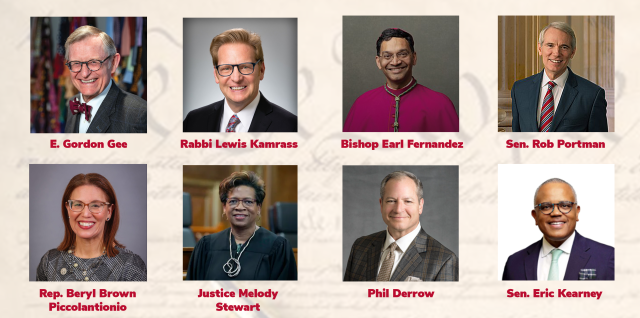
Confirmed Guest Leaders Include
- Bishop Earl Fernandes – Catholic leader and advocate for moral clarity in public life
- Rabbi Lewis Kamrass – Champion of interfaith dialogue and civic responsibility
- Senator Rob Portman – Former U.S. Senator with a legacy of bipartisan leadership
- Representative Beryl Brown Piccolantonio – State and local government leader focused on equity and community engagement
- Justice Melody Stewart – Ohio Supreme Court Justice and trailblazer in legal ethics and education
- President Gordon Gee – Visionary university president and higher education reformer
- Phil Derrow – Business executive and civic entrepreneur committed to workforce development
- Senator Eric Kearney – Legislative leader and civic innovator advancing equity and economic opportunity
Course Highlights
- Weekly discussions on leadership, identity, and institutional transformation
- Bi-weekly student presentations connecting theory to practice
- Honors students complete a CRIG Project (Creativity, Resilience, Independence, Grit)
This course is ideal for students interested in public service, law, education, business, nonprofit leadership, or anyone seeking to understand how personal agency intersects with civic life.