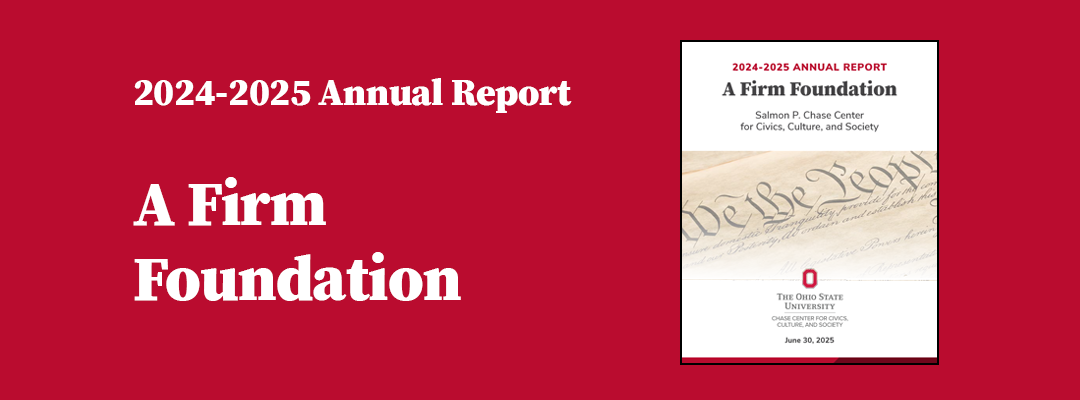
Message from the Executive Director
The founding of an organization is an auspicious moment.
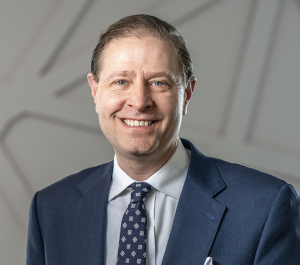
It holds out the hope of future greatness, yet it can also sow the seeds of future decline. As a lawyer, I am especially sensitive to the importance of creating sound precedents that will ground and guide long into the future. In that spirit, I am delighted to share with you the Salmon P. Chase Center for Civics, Culture, and Society’s 2024-2025 annual report.
Over the past academic year—the Chase Center’s founding year—we laid sound precedents in all of the key areas of the Center’s academic life. As this report details, the Chase Center’s mission of citizenship education is on a firm foundation and will be secure long into the future.
Most importantly, the Chase Center hired its founding faculty and administration who came to the Center to create a new academic community dedicated to the American civic tradition. Personnel is mission. This report details the Center’s many additional successes and shares select challenges it faced in its founding year.
The Chase Center represents a once-in-a-lifetime opportunity to enhance one of America’s great public universities. The Chase Center will provide thousands of Ohio State students with an education that exposes them to the historical ideas, traditions, and texts that have shaped the American constitutional order and society—often for the first time in their lives!—and enhance the entire University by recruiting faculty of diverse viewpoints to teach and research.
The Chase Center’s classes will share with students the great good that is the United States—a genuine good that has the capacity to unite Americans of all backgrounds and viewpoints, and thereby knit us into a more perfect Union.
Yours in Citizenship Education,
Lee J. Strang
Executive Director, Salmon P. Chase Center for Civics, Culture, and Society
Professor of Law, Moritz College of Law
The Ohio State University
June 30, 2025
Executive Summary
As part of its multi-pronged, nation-leading effort to reform higher education, Ohio established the Salmon P. Chase Center for Civics, Culture, and Society in 2023, with the mission to “conduct teaching and research in the historical ideas, traditions, and texts that have shaped the American constitutional order and society.” ORC § 3335.39(A)(1).
Under the leadership of its inaugural Executive Director, Lee J. Strang, since August, 2024, the Center has created a robust academic community to carry out this important mission.
Leadership, Faculty, and Staff
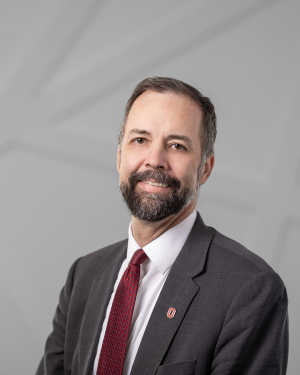
In August, 2024, Professor Strang was appointed as the Executive Director of the Center. Professor Strang immediately began the process of building the Center’s leadership team. After hiring an executive assistant and project manager in January, 2025, Dr. Jeremy Fortier and Dr. Jonathan Spiegler joined the Center as Assistant Directors.
The Chase Center, assisted by Ohio State faculty from law, political science, and public policy, created a faculty hiring committee. It began advertising for two associate directors and faculty of all ranks in January, 2025. It received hundreds of applications. On February 11, 2025, the Center embarked on its first of approximately 30 in-person faculty interviews that were conducted through the end of April, 2025.
Utilizing more than 30 volunteer faculty from a variety of departments throughout Ohio State, the Chase Center focused on hiring scholars from both junior and senior ranks in disciplines relevant to citizenship education. The Center hired over 20 inaugural faculty. Faculty hired include two full professors, two associate professors, ten assistant professors, one associate professor of teaching, two lecturers, one visiting professor, and three post-doctoral scholars. Most faculty begin in August, 2025.
These faculty come from the most prestigious universities in the United States (Johns Hopkins University, Stanford University, the University of Virginia, Yale University) and around the world (Cambridge University, Oxford University, St. Andrews University), and have published in leading academic presses (the University of Chicago, Cambridge, Cornell, Oxford, Yale). Incoming faculty have been involved in cutting-edge research highlighting the origins of America’s civic tradition, the psychology of polarization and civic dialogue, virtue ethics, and how as citizens we can better discuss claims made by science and religion. They have the expertise required to excavate and preserve the most valuable aspects of America’s distinctive approach to self-government.
The Chase Center’s faculty will also enrich Ohio State’s intellectual diversity through the new classes they will offer, the research questions they will pursue, and the answers they will propose.
As noted, the Chase Center simultaneously conducted a search for two associate directors. The associate directors support the Chase Center by overseeing all matters pertaining to the execution of the Center’s mission; they report to the executive director.
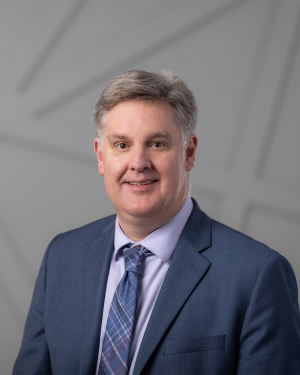
In May, 2025, Christopher Green and Brian Schoen joined the Center as associate directors. Prior to joining the Chase Center, Professor Green was Professor of Law and Jamie L. Whitten Chair in Law and Government at the University of Mississippi School of Law for 19 years. Professor Green’s research is primarily on the Fourteenth Amendment and originalist theory. Professor Green is a graduate of Yale Law School (J.D.) and the University of Notre Dame (Ph.D.), and his duties as Associate Director focus on external relations.
Dr. Schoen, a graduate of the University of Virginia (Ph.D.), was previously the James Richard Hamilton/Baker & Hostetler Professor of Humanities and Chair of the Department of History at Ohio University, where he taught for the past 15 years. Dr. Schoen’s research focuses on early American history. As Associate Director, Dr. Schoen administers academic affairs.
Both Dr. Schoen and Professor Green bring a passion for the Center’s mission, excellent scholarship, and administrative experience.
Note
The assistant directors are staff. The Center did not immediately pursue hiring tenure-track associate directors or faculty because the University’s initial posture was that the Center could not do so. This posture changed in February, 2025.
Public Lectures and Programs
Over the course of the year, the Center developed a robust range of public programs aimed at fostering civic engagement and promoting a deeper understanding of the American civic tradition. These programs included lectures, conversations, student writing contests, and symposia that brought together scholars and practitioners to discuss critical issues in civic thought and leadership.
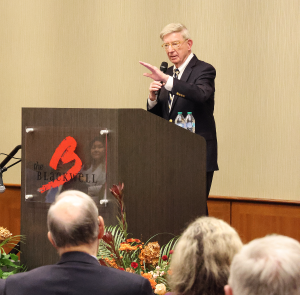
The Center’s inaugural event, “Conversation with the Presidents: Citizenship Education at America’s Leading Research Universities”, took place on March 25, 2025. This event featured a discussion between The Ohio State University President Walter “Ted” Carter, Jr., and Johns Hopkins University President Ronald J. Daniels, on the role of research universities in educating and preparing students to be engaged citizens. Moderated by Professor Strang, this event marked the beginning of the Center’s public-facing programming and set the stage for future initiatives. More than 120 people, including students, faculty, staff, board of trustees members, executive leadership, academic advisory council members, and state officials attended this successful inaugural event.
The Chase Center is honored to take the reins of The Salmon P. Chase Distinguished Lecture Series, which began 25 years ago at the Georgetown Center for the Constitution and was given to the Chase Center by Professor Randy Barnett. The Chase Lecture presents American civic lives well-lived. The Chase Center kicked off the inaugural lecture at Ohio State with a discussion of Salmon P. Chase as a model of civic leadership with Walter Stahr, the author of the leading biography of Chase.
The capstone of the Center’s public events was the first annual Ohio Civics Centers Symposium on April 25, 2025. The Center hosted all of the civics centers in Ohio—the five state-created and seventeen others from Ohio’s public and private universities—for the Symposium. There, the Chase Center put its Ohio counterparts in conversation with each other and with national thought leaders of citizenship education including, for instance, Benjamin Storey, Josh Ober, and John Rose, among many others.
The Center has an impressive array of public events scheduled for academic year 2025-2026. The Chase Center will celebrate Constitution Day on September 15, 2025, with a lecture delivered by Dr. Lucas Morel. Dr. Morel’s lecture is titled: “Frederick Douglass, Free Speech, and ‘the Right of the Hearer.’”
The Chase Center will host the first-ever scholarly “Conference on Civic Thought and Leadership” on September 26-27, 2025. This conference will bring together scholars from disciplines relevant to citizenship education to present papers, engage in conversation, and build fellowship.
The second installment of the Chase Lecture Series at Ohio State will take place November 4, 2025, with Dr. Allen Guelzo, a leading historian of the Civil War period and the leading expert on Abraham Lincoln. Dr. Guelzo will deliver a lecture on Salmon Chase’s relationship with Lincoln.
Other public programming coming next academic year includes a distinguished lecture by George Will, “A Front Seat at the Conservative Movement”, on November 13, 2025. On January 20, 2026, the Chase Center will host Dr. Danielle Allen for its annual Rev. Martin Luther King, Jr., Lecture and an invited faculty workshop.
Collaboration with Ohio State Partners
Even prior to his official start date on August 26, 2024, Professor Strang began the process of relationship building with potential Ohio State partners. Professor Strang initiated and hosted over 120 meetings in his first five months with University leaders, department chairs, faculty, student groups, and affiliated student organizations. At each meeting, he shared his positive vision for the Chase Center and invited collaboration with the potential partner. These outreach efforts paid many dividends.
The Chase Center has established relationships with the College of Arts and Sciences, the College of Law, the John Glenn College of Public Affairs, the Center for Ethics and Human Values, and the Institute for Democratic Engagement and Accountability, among others. The partnerships include: co-organizing a conference on “Originalism and Criminal Justice” with the College of Law; Chase faculty teaching in Arts and Sciences’ Philosophy, Politics, and Economics program; and hosting faculty fellows from the John Glenn College and Arts and Sciences. A number of Ohio State faculty are joining the Center as Chase Faculty Fellows, who will enrich the Center’s academic life through courses, research, and lectures.
Curriculum
The Chase Center’s curriculum is focused on educating citizens and civic leaders. Its rigorous course of study will enable students to both understand the foundational principles of American society and identify when and how to apply, reinforce, and advance those principles to address present and future challenges. Coursework will therefore center on the texts and major debates that have formed the intellectual foundation of free societies, and on the principles, ideals, and institutions of the American constitutional order.
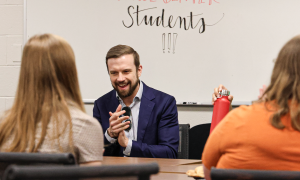
The Chase Center’s course offerings will be characterized by four related components. First, Chase’s curriculum invites students to pursue high standards and to achieve academic excellence. Second, courses will focus on reading and understanding primary texts. Third, each course will include significant research and writing, along with oral communication. Fourth, classroom culture will encourage civil debate and discussion.
Classes will generally be small and taught as seminars that strongly encourage active student participation. Students will both voice their own opinions and be interested in listening with an open mind to opposing views with the aim of discovering as much of the truth as possible.
The Chase Center’s curriculum provides a broad grounding in important texts and topics, and so will offer a wide array of classes, likely to include: The American Civic Tradition; The Art of Statesmanship and the Civic Life; American Civic Life Through Literature; The Pursuit of Happiness; Truth and Persuasion; Self-Government and Science; Religion and Politics; American Conservativism and Liberalism; The American Founding and Political Thought; American Constitutionalism; Capitalism and its Critics; American Culture Wars; Self-Government on the World Stage; and the Senior Thesis capstone course.
The Center is offering its first course this Fall: The American Civic Tradition. This foundational course has three alternative tracks: The American Civic Tradition: Creeds, Conflicts, and Cooperation, introduces students to the development of American civic thought; The American Civic Tradition: Then and Now, introduces students to the development of the American civic tradition, from the period of the colonies and the Founding, through the Civil War, and up to the present day; and the third track, The American Civic Tradition: Foundational Debates, introduces students to foundational debates that have shaped the American civic tradition. Each course asks students to engage directly with primary texts from the American tradition, while surveying their historical and present-day impact on debates in constitutionalism, religion, economics, and more.
The Chase Center is currently building a certificate, a minor, and a major in Civics, Law, and Leadership (by Fall, 2026), and over the next two years will stand up two additional academic programs: a Transformative Texts (or Great Books) program (Fall, 2027); and a program aimed at enhancing the civic education taught in K-12 classrooms in Ohio and nationally (Fall, 2027).
Student Program
The Chase Center in in the process of launching its student program, the Chase Scholars Program, which will begin in Fall, 2025. The student program is the institutional form of the Center’s invitation to students to join the Center’s community. The Chase Center is an academic community intentionally committed to civil debate and discussion. Students are invited to join this community where they know they will debate and discuss important issues of law, policy, ethics, and religion with their fellow students, including those with whom they disagree.

The Chase Scholars Program provides opportunities that extend beyond the classroom. To this end, the Center sponsors extracurricular opportunities including lectures given by outside speakers and Chase faculty, small student reading groups led by Chase Center professors, film screenings, research workshops, and social events. The students will come to share friendship with each other precisely through this mutual intellectual engagement.
When fully mature, there will be three options available for undergraduate students wishing to participate in the Chase Center student program: Chase Fellows, Chase Scholars, and Chase Members. Chase Fellows is the highest level within the program, and students will receive a $4,000 scholarship per academic year. To maintain membership, Fellows will take one Chase Center course per semester in a sequence of eight courses that will result in a major. Fellows will also receive internship advising, a study abroad opportunity, books for all Center courses for free, an invitation to all Chase Center events, and will participate in at least four Center events per semester.
Chase Scholars will receive a $2,000 scholarship per year. To maintain membership, Scholars will take at least four Chase Center courses that result in a minor, and they will receive internship advising, a domestic travel opportunity, books for all Center courses for free, and an invitation to all Center events. Scholars will participate in at least two Chase Center events per semester.
The last level of the student program is the Chase Member. Chase Members will receive an invitation to all Chase Center events, and books for Chase Center courses for free.
The Chase Center has kicked off the Chase Scholars Program just in time for new student Summer orientation. At orientation, new students have the opportunity to meet with Chase Center faculty and learn ways they can get involved with the Chase Center and earn scholarships toward their educational goals.
Prior to the formal start of the student program, the Chase Center held a writing contest on March 22, 2025. Twenty-five undergraduate students wrote a 1000-word essay on the prompt: Is freedom of speech valuable or harmful to the United States? This was an opportunity for students to explore principles of free speech and civil discourse, while honing their research and writing skills. Students wrote their essays in hopes of winning one of three possible scholarships from the Chase Center. The first-place student, Min Feldman, won a $3,500 scholarship; second place won a $2,500 scholarship and was awarded to Prisha Patel; and third place won a $1,500 scholarship and was awarded to Paige Lange. Winners were announced April 8, 2025, at the first Salmon P. Chase Distinguished Lecture.
K-12 Outreach
The Chase Center is forming strong connections with K-12 partners in order to support civics education more broadly, to increase the number of applicants to the Chase Center, and to secure job opportunities for Chase graduates.

By Fall, 2027, Chase will offer a B.A. in classical education and an M.A. in classical school administration for the burgeoning classical school movement in Ohio and throughout the nation, which faces a drastic shortage of both teachers and administrators. Second, the Chase Center will provide in-person and virtual civics training and curriculum materials to existing K-12 teachers in all schools (public, private, conventional, classical), including pre-packaged curricula that give teachers ease of use. Third, the Center will serve as a point of coordination and vehicle of cooperation for the public and private classical schools in Ohio.
A concrete manifestation of this support will occur on August 1, 2025, when the Chase Center will host the first annual Ohio Classical Schools Conference. Conference invitations went to classical schools throughout Ohio, public and private, and were aimed at administrators, principals, headmasters, and board members. The conference will consist of panels covering the state of the classical school movement, leadership at classical schools, classical school culture and mission, and Ohio classical schools and higher education. The keynote presentation, to be given by Ohio Rep. Beth Lear, will focus on Ohio’s legislative update.
Chase is also supporting the Ohio Civics Bee and the High School Law Review.
Philanthropy
The Chase Center is developing an effective fundraising program to foster the future of civic thought and leadership, and to provide a collaborative vision for supporting the Chase Center in ways that can help elevate academic excellence.
The Chase Center has been cultivating numerous financial supporters with significant success. For instance, the Center recently secured a $3 million gift from the Stanton Foundation to support the Center’s promotion of a culture of free speech. This initiative is multifaceted with a wide range of programs and events designed to foster a deeper understanding of free speech. The gift will help support an annual conference on civic thought and leadership, the annual Ohio Civics Centers Symposium, a signature debate on civic thought, K-12 initiatives, post-doctoral fellows on civic thought, graduate assistant fellows of civic thought, undergraduate fellows of civic thought, a visiting scholar, and a journal of civic thought and leadership.
The Center has also built a strong relationship with the Jack Miller Center, which generously awarded the Chase Center a $20,000 gift that supported the Ohio Civics Centers Symposium. More support is forthcoming.
The Center has worked hard to show the value that the Chase Center and sister centers are providing to Ohio. As a result of this relationship building, the Center anticipates increased support from Ohio in the State’s upcoming budget.
Location
The Chase Center will be temporarily located in a dedicated space in Smith Laboratory after August 1, 2025. This space will allow faculty and staff to swiftly integrate within the campus and engage with the student body.
Over the next three years, the Chase Center is working with Ohio State to renovate Ramseyer Hall, which will be the Center’s permanent home. University support for the Center’s permanent home has been robust and is appreciated.
Challenges
As with any new endeavor within an existing institution, especially an endeavor that is reform-oriented, the Chase Center has encountered challenges. Some of these challenges are the product of the Center’s newness, some the product of reasonable good-faith disagreement, and some the product of unsound claims.
The Chase Center began with and continues to pursue the goal of building positive working relationships with all parts of Ohio State. As part of that effort, and with the support of the Administration and Board of Trustees, the Center pursued University Senate approval for something known as “University Center” status. To make a complicated story short, the Center’s proposal was extensively reviewed by the Council on Academic Affairs and approved by a vote of 13-3, and the University Senate narrowly failed to approve the proposal. Though disappointing, three good consequences flowed from this action. First, the Chase Center demonstrated to all reasonable observers that it genuinely and in good faith was pursuing its mission to enrich all members of Ohio State. Second, the Board of Trustees at its next meeting stated via resolution that it “fully supports” the Chase Center and enshrined the Center’s statutory authority within Ohio State policy. Third, the University Senate’s actions showed the need for the Chase Center to enrich the University’s academic community. Moreover, as noted earlier, the Center continues to successfully build partnerships with faculty and academic units throughout Ohio State because of its good faith outreach.
The Chase Center has had development success with the support of the Office of Advancement, and its success will be increased when it has the expanded capacity provided by its own dedicated development staff.
Similarly, the Center has successfully cultivated support among state officials in all branches and political parties for the Center’s good work and that of the other four Ohio civics centers. The Center welcomes enhanced support from the University in this endeavor.
As noted, the Chase Center had a very successful year of hiring founding faculty with the University’s assistance, but filling staff positions has proceeded slowly.
Fourth, because it was deemed prudent to work within the University’s existing frameworks for curricular development, the process of launching our robust package of courses and degrees is more time consuming than initially envisioned.
The Center is happy to provide additional information on these challenges.
Conclusion
The Chase Center is an intentional response by Ohio to a worrying lack of knowledge about the United States, especially among young Americans, and to our current incivility. As Aristotle explained over two thousand years ago, citizens of a political community need to have a shared love of shared goods.
The Chase Center teaches our young people about the many—and many good—things that we Americans share in common; what Aristotle called the common good. And the Center imparts the skills and disposition required for fellow citizens to treat each other with respect; what Aristotle called civic friendship.
The past year has been a period of building a firm foundation for the Salmon P. Chase Center for Civics, Culture, and Society. With a strong leadership team and founding faculty in place, and a series of impactful programs underway, the Center is well-positioned to become the national leader in citizenship education.