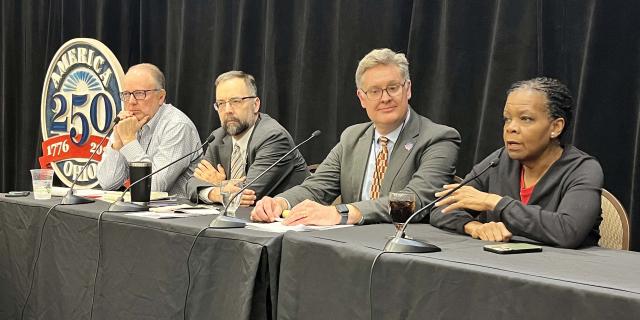
Nearly 100 primary and secondary school educators, scholars, public historians, and members of the public with an interest in the importance and legacy of the Northwest Ordinance attended the second day of “New Perspectives of the Northwest Ordinance,” a conference held at The Ohio State University Jan. 30-31.
The second day, which was largely organized by the Salmon P. Chase Center and America-250 Ohio, included a series of panel discussions geared toward K-12 teachers from around Ohio.
“As our nation begins its yearlong celebration of the 250th anniversary of the signing of the Declaration of Independence, the topic of this conference was a natural fit for the Chase Center,” said Brian Schoen, Chase Center Associate Director. “The Northwest Ordinance was instrumental in the westward growth of our nation, but its importance as one of America’s foundational documents is often overshadowed when teaching U.S. history and civics.”
Five panels presented diverse topics on Saturday, including how K-12 teachers can incorporate the Northwest Ordinance into their instruction. Saturday’s final panel included author Annette Gordon-Reed, whose book “The Hemingses of Monticello” won the Pulitzer Prize.
“Even 250 years after the birth of our nation, it is important to explore the documents, philosophies, and events that served as the foundation of our nation,” Schoen said. “These are not just yellowed pieces of paper under display cases in museums. They represent ideas that have impacted our nation since Day One, and still resonate in our current government, legal system, and daily lives.”
The Northwest Ordinance was adopted by the Confederation Congress in 1787. It defined laws and structure for future states northwest of the Ohio River, including the prohibition of slavery in what would become Ohio, Michigan, Indiana, Illinois, Wisconsin and parts of Minnesota.
“History can be messy,” Schoen said. “Not all ideals of the Northwest Ordinance were realized, especially its call for the fair treatment of Native Americans. Yet, crucially, the Northwest Ordinance established a foundation for public education and a blueprint for the nation. Its legal prohibition of slavery over such a large track of land was unprecedented in its day, and to a great extent defined the career of Salmon P. Chase, a leading political abolitionist for whom the center is named.”
Schoen said studying the ordinance aligns with the Chase Center’s priorities.
“When the Chase Center was officially created by an act of the Ohio Legislature in 2023, part of its charge was to teach and research the importance and lasting effects of these founding documents,” Schoen said. “This is not just something we focus on at the university level. There also is a need to invigorate how civics, history, and social studies are taught at primary and secondary schools, which is one of our goals. The parts of this conference that focused on ‘teaching the teachers’ were designed to provide resources and strategies to achieve that purpose.”
The first day of the conference had content aimed more toward scholars from The Ohio State University and other colleges and universities. It was organized by the America 250 Ohio commission, the Ohio State Mershon Center for International Security Studies, and the Ohio State Department of History.
The conference ended Saturday night with author Gordon-Reed offering a keynote address.
Get more information about Ohio State's America 250 programming.