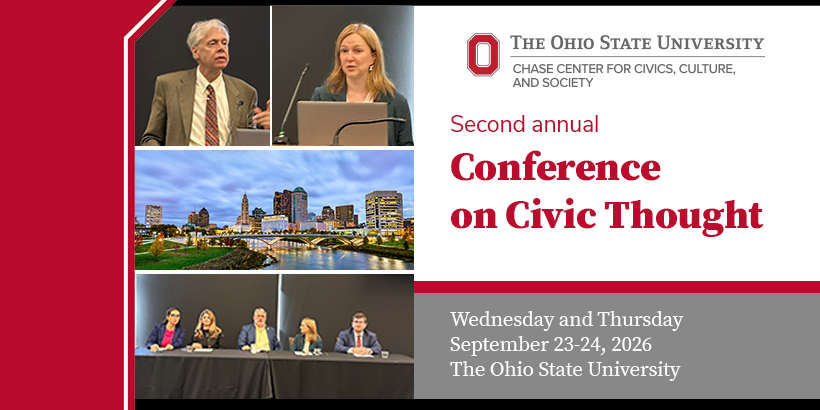
The second annual Conference on Civic Thought, hosted by the Salmon P. Chase Center for Civics, Culture, and Society at The Ohio State University, takes its bearings from a remarkable year. In 1776, within months of one another, there appeared Thomas Paine's Common Sense, the first volume of Edward Gibbon's Decline and Fall of the Roman Empire, Adam Smith's Wealth of Nations, and the Declaration of Independence. Together, these works frame enduring questions about rights, self-government, empire, commerce, and the conditions of a free people.
The 2026 conference will feature:
- Keynote addresses by William Inboden, Executive Vice President and Provost of the University of Texas-Austin, and Josiah Ober, the Constantine Mitsotakis Chair in the School of Humanities and Sciences at Stanford University,
- Plenary sessions by Thomas Howe and Kevin Vallier on post-liberalism, Brennan McDavid on Adam Smith, Michael Moses on the American West in film and novels as a representation of American civic thought, and Edward Watts on Gibbon's account of the fall of Rome,
- Panels on the thinkers and texts above, and
- A poster competition for undergraduate students.
Conference Information
Please see below for information about this conference.
Agenda
Wednesday, September 23
2-3:30 p.m.: Registration (Top of stairs, Ballroom)
3:30 p.m.: Concurrent Panels Session #1
- Panel A (Ballroom): “Early Career Roundtable”
- Panel B (Pfahl 302): “Democracy, Citizenship, and Freedom”
- Panel C (Pfahl 202): “Natural Law, the Declaration, and Rights”
- Panel D (Pfahl 140): “The Protestant Founding: Reformation Thought and History in Early American Civic Life”
- Panel E (Pfahl 330): “Reconsidering the Declaration”
4:45 p.m.: Break
5:30 p.m.: Reception (Pfahl Hall first floor foyer)
6:30 p.m.: Dinner buffet (Ballroom hallway)
7 p.m. Welcome
- Lee Strang, Salmon P. Chase Center Executive Director
7:05 p.m.: Keynote #1: William Inboden, University of Texas at Austin (Ballroom)
- “1776, the Cold War, and the Power of Ideas in Geopolitics”
Thursday, September 24
7:30-9 a.m.
- Undergraduate Poster Competition (Pavillion)
- Breakfast (Ballroom)
- Registration (Top of stairs, Ballroom)
9 a.m.: Plenary Session #1: Edwards Watts (Ballroom)
- “Imagining the Future by Looking to the Past: Gibbon’s Decline and Fall of the Roman Empire and the Legacy of 1776”
9:45 a.m.: Break
9:55 a.m.: Plenary Session #2: Brennan McDonald (Ballroom)
- “Adam Smith on the Civic Purpose of a Liberal Education”
10:40 a.m.: Break
10:50 a.m.: Concurrent Panels Session #2
- Panel A (Ballroom): “Intellectual Influences on the American Founding”
- Panel B (Pfahl 302): “Civility and Civic Virtue”
- Panel C (Pfahl 202): “How Did the Founders Understand Social Contract Theory?”
- Panel D (Pfahl 140): “How Should Higher Ed Support K-12 Civics Teachers?”
- Panel E (Pfahl 330): “A.I. and Civics”
12:05 p.m.: Break and lunch buffet (Pavillion)
12:15 p.m. Keynote #2: Josiah Ober, Stanford University (Ballroom)
- “Civic Education for Civic Democracy 1776-2026”
1:15 p.m.: Break
1:25 p.m.: Plenary Session #3: Michael Valdez Moses (Ballroom)
- “Outlaw Country: Violence, Law, and the State in John Ford’s ‘The Man Who Shot Liberty Valance.’”
2:10 p.m.: Break
2:20 p.m. Concurrent Panels Session #3
- Panel A (Ballroom): “Civics, Centers, and Gen Ed”
- Panel B (Pfahl 302): “The Unfinished Work of 1776: Rights, Equality, & Popular Sovereignty in American Reform”
- Panel C (Pfahl 202): “Doux Commerce Reconsidered: Albert O. Hirschman’s The Passions and the Interests at Fifty”
- Panel D (Pfahl 140): “Natural Rights, Natural Law: The Legacy of the Declaration”
- Panel E (Pfahl 330): “Accounting for Civic Virtue”
3:35 p.m.: Break
3:45 p.m. Plenary Session #4: Kevin Vallier, James Patterson, and Thomas D. Howes (Ballroom)
- “Did Postliberalism Fail?”
4:30 p.m. Closing remarks
- Lee Strang, Salmon P. Chase Center Executive Director
5 p.m. Reception (Pfahl Hall first floor foyer)
Keynote and Plenary Speakers
Thomas D. Howes
Lecturer in the University Center for Human Values, Princeton University
Thomas D. Howes lectures and writes on ethics and politics. He is also involved in social entrepreneurship in various roles. He has co-authored, along with James M. Patterson, Why Postliberalism Failed at Acton Institute and has a forthcoming book manuscript with the provisional title Beyond Postliberalism: Natural Law & Constitutional Democracy.
William Inboden
Executive Vice President and Provost, University of Texas at Austin
William Inboden began serving as executive vice president and provost at the University of Texas at Austin on Aug. 1, 2025. He also holds the William Powers Jr. Chair and a joint faculty appointment with the Department of History and the School of Civic Leadership. As the University’s chief academic officer, he leads UT Austin’s academic mission and ensures the excellence and continued innovation of research and teaching endeavors across campus.
These responsibilities cover academic programs and initiatives across the University’s 16 colleges and schools, which serve more than 55,000 students and support more than 4,600 teaching and research faculty. In addition, Dr. Inboden oversees UT Austin’s libraries and museums, archival collections, and academic support units.
Most recently, Dr. Inboden served as director of the Alexander Hamilton School for Classical and Civic Education at the University of Florida and Peterson Senior Fellow with the Kissinger Center for Global Affairs at the Johns Hopkins School of Advanced International Studies.
Brennan McDavid
Assistant Professor of Philosophy, Chapman University
Brennan McDavid is an assistant professor of philosophy at Chapman University’s Smith Institute for Political Economy and Philosophy. In January, she will join the Hamilton School for Classical and Civic Education at the University of Florida. She has a PhD from Princeton’s Classical Philosophy Program and specializes in ancient Greek philosophy, with particular interests in the moral psychology and political economy of Plato and in the conversation between classical thought and the early modern tradition. She is the author of Nature and Nurture in Plato’s Noble Lie, under contract with Cambridge University Press in the Elements in Ancient Philosophy series, and her articles have appeared in Ancient Philosophy, Classical Quarterly, Journal of the History of Philosophy, History of Political Economy, Plato Journal, and Polis.
Michael Valdez Moses
Professor, Chapman University
Michael Valdez Moses grew up in Los Angeles and was educated at Harvard, New College, Oxford, and the University of Virginia. He is the author of The Novel and the Globalization of Culture (Oxford UP, 1995) and has edited several collections of critical essays, including The Writings of J. M. Coetzee (Duke UP, 1994), Modernism and Colonialism: British and Irish Literature, 1900-1939 (Duke UP, 2007), and Modernism and Cinema (Edinburgh UP, 2010).
His main interests are in modern comparative literature (especially British, Irish and postcolonial), the history of film, and in the interdisciplinary study of literature, political philosophy, and economics.
Josiah Ober
Constantine Mitsotakis Chair in the School of Humanities and Sciences, Stanford University
Josiah Ober, the Constantine Mitsotakis Chair in the School of Humanities and Sciences, specializes in the areas of ancient and modern political theory and historical institutionalism. His primary appointment is in Political Science; he holds a secondary appointment in the Classics and courtesy appointments in Philosophy and the Hoover Institution. His most recent books are The Greeks and the Rational: The Discovery of Practical Reason (University of California Press 2022) and Demopolis: Democracy Before Liberalism in Theory and Practice (Cambridge University Press 2017). His ongoing work focuses on rationality (ancient and modern), the theory and practice of democracy, and the politics of knowledge and innovation. Recent articles and working papers address AI ethics, socio-political systems, economic growth and inequality, the relationship between democracy and dignity, and the aggregation of expertise.
James Patterson
Associate Professor, Institute of American Civics, University of Tennessee
James Patterson is an associate professor of public affairs for the Institute of American Civics at the Baker School of Public Affairs and Public Policy at the University of Tennessee, Knoxville. He has written one scholarly book, Religion in the Public Square: Sheen, King, Falwell (University of Pennsylvania Press, 2019), and is currently completing another with his co-author Thomas Howes titled Why Postliberalism Failed (Acton Institute, 2026). His next book project will concern the development of the ideas and institutions behind American Catholic republicanism.
Kevin Vallier
Professor of Philosophy and Director of Research at the Institute for American Constitutional Thought and Leadership, University of Toledo
Kevin Vallier is a Professor of Philosophy at the University of Toledo’s Institute for American Constitutional Thought and Leadership. Vallier’s interests lie primarily in political philosophy, ethics, philosophy of religion, and philosophy, politics, and economics (PPE). He is the author of four monographs, five edited volumes, and over fifty peer-reviewed book chapters and journal articles. His books include Liberal Politics and Public Faith: Beyond Separation (Routledge, 2014), Must Politics Be War? Restoring Our Trust in the Open Society (Oxford UP, 2019), and Trust in a Polarized Age (Oxford UP, 2020). His new book is All the Kingdoms of the World: On Radical Religious Alternatives to Liberalism (Oxford UP, 2023).
Edward Watts
Alkiviadis Vassiliadis Professor of History, University of California, San Diego
Edward Watts received BAs in Classics and Ancient and Medieval Culture at Brown University. He received his PhD in History from Yale University in 2002. His research interests center on the intellectual, political, and religious history of the Roman Empire and the early Byzantine Empire. He is the author of seven books and the editor of five more, including The Final Pagan Generation (UC Press, 2015), Mortal Republic: How Rome Fell into Tyranny (Basic Books, 2018), and The Eternal Decline and Fall of Rome: The History of a Dangerous Idea (Oxford University Press, 2021).
Panelists
Concurrent Panel 1
Panel A (Ballroom): “Early Career Roundtable”
• Jack Carlson (University of Texas at Austin), “Thomas Paine’s Conception of Human Nature and Society”
• Trinity Duggan (Hillsdale College), “Nil Admirari Nil Contemni: A Defense of John Adams’ View of Parties in America”
• Marisol Balderas (Hillsdale College), “The Partisanship of Calvin Coolidge”
• Corey Horn (Whitworth University), “What Is Civic Education For? Democratic Freedom Beyond Constitutional Literacy”
• Luke Sherman (Hillsdale College), “A Legal and Cultural Division: Two Modes of Dividing Sovereignty”
Panel B (Pfahl 302): “Democracy, Citizenship, and Freedom”
• Dan Demetriou (Washington Center, West Virginia University), “A Friendlier Fight: Civil Discourse for Irreconcilable Adversaries”
• Colin Wilder (University of South Carolina), “The Relationship between Civics, History, and Freedom in Historical Thought from Polybius to Hayek”
• Jason Lantzer (Butler University), “The Neglected Legacy of 1776: The Northwest Ordinance and America’s Founding”
• Thomas Finan (Boston University), “ ‘Truck, Barter, and Exchange’: An Ethics of Interdependence for the Market”
Panel C (Pfahl 202): “Natural Law, the Declaration, and Rights”
• Joseph Yi (Hanyang University), “Rights Narratives and the Conditions of Self-Government: Procedural Liberalism in South Korea”
• Ben Haines (University of Wisconsin-Madison), “Pursuing Happiness: John Locke and the Moral Foundations of the Declaration of Independence”
• Alexander Schmid (The Stephenson Institute, Wabash College), “The Medieval Architecture of American Republicanism: Dante Alighieri, the Federalist, and the Realist Critique of Universal Order”
Panel D (Pfahl 140): “The Protestant Founding: Reformation Thought and History in Early American Civic Life”
• Chair: Daniel Gullotta (Salmon P. Chase Center, The Ohio State University)
• Respondent: James Hooks (Salmon P. Chase Center, The Ohio State University)
• Alexander Batson (University of Texas at Austin), “Christian Natural Law, or Protestant Natural Law? Post-Reformation Natural Jurisprudence and the American Founding”
• Samuel Young (Indiana Wesleyan University), “Mosheim vs. Hume and Gibbon: The Battle over Reformation Historiography in the Early Republic”
• James Howard (James Madison Program, Princeton University), “The Protestant Spirit of ’76: Religious Liberty, the Slave Power, and American Abolitionism”
• Rodolfo Hernandez (Kinder Institute, University of Missouri), “That Time the Devil Beat Daniel Webster: the Case of Vidal v. Girard’s Executor’s (1844)”
Panel E (Pfahl 330): “Reconsidering the Declaration”
• Jason Stevens (Ashbrook Center, Ashland University), “The Lost Debate: Abraham Lincoln, Stephen Douglas, and the ‘Old Line Whig’ ”
• Casey Spinks (Miami University), “How to Read the Declaration in 2026”
• Nathaniel Fouch (Capital University Law School), “The Relationship Between the Declaration of Independence and State Constitutions”
• Jonathan Scriven (Washington Adventist University), “Before 1776: Teaching the Colonial Foundations of the Declaration of Independence”
Concurrent Panel 2
Panel A (Ballroom): “Intellectual Influences on the American Founding”
• Discussant: Keith Hankins (Hamilton School, University of Florida)
• Jeffrey Collins (Hamilton School, University of Florida), “John Locke and the Principles of the Founding”
• Thomas Vozar (Hamilton School, University of Florida), “John Milton, Founding Father? Republicanism, Religious Liberty, and Intellectual Freedom in Revolutionary America”
• Brandon Warmke (Hamilton School, University of Florida), “Conservative Themes in the Declaration”
• Jeffrey Schulman (American Council of Trustees and Alumni), “Why Did the Founders Pay So Little Attention to Gibbon and the Late Roman Empire?”
Panel B (Pfahl 302): “Civility and Civic Virtue”
• Bernard Dobski (Assumption University), “Mark Twain, America’s Homer: Democratic Literature and the Novel Re-Founding of America (or, The Incredibly Huge, Utterly Massive, and Obscenely Ambitious Goals of Twain’s Fiction)”
• Samantha Jo Fried (Tufts University), “Extending the Periodic Table of Expertise to the Humanities”
• Prakash Chenjeri (Southern Oregon University), “When Civility Becomes Performance: Civic Education as the Foundation of Public Reason”
• J. Cherie Strachan (The University of Akron), “First Comes Trust, Understanding the Circumstances that Allow Civic Virtue, or Self-Interest Rightly Understood, to Flourish”
Panel C (Pfahl 202): “How Did the Founders Understand Social Contract Theory?”
• Daniel Burns (University of Dallas), “America’s New and Homegrown Social Contract Theory”
• Paul DeHart (Texas State University), “Classical Natural Law and Government by Consent: The American Synthesis”
• Michael Hawley (UNC Chapel Hill), “Civic Prejudice and Civic Skepticism in The Federalist”
• Jacob Williams (Princeton University), “The Anti-Caesar Doctrine: Harry Jaffa’s Aristocratic Case for Civic Equality”
Panel D (Pfahl 140): “How Should Higher Ed Support K-12 Civics Teachers?”
• Moderator: Adam Seagrave (Teaching American History, Ashbrook Center)
• Kimberley Huffman (Wayne County Schools Career Center)
• Lucas George (Grandview Heights High School)
• Melanie Stuthard (Revere Local Schools)
Panel E (Pfahl 330): “A.I. and Civics”
• Kevin Vallier (Institute for American Constitutional Thought and Leadership, University of Toledo), “Civic Virtue in the Age of Artificial Intelligence”
• Ian Church (Hillsdale College), “Generative A.I. and the Future of Public Knowledge”
• Patrick Lee Miller (Washington Center, West Virginia University), “A.I. and Statesmanship”
• Josiah Lippincott (Washington Center, West Virginia University), “Cybernetic Government: AI and the Political Question”
Concurrent Panel 3
Panel A (Ballroom): “Civics, Centers, and Gen Ed”
• Moderator: Nick Down (American Council of Trustees and Alumni)
• Melinda Zook (Purdue University), “Liberal Education at Scale: Cornerstone at Purdue University”
• Mark Bauerlein (Emory University and Salmon P. Chase Center, The Ohio State University), “The Art of Civics”
• Paul Carrese (Arizona State University and The Jack Miller Center), “Restoring American Civics as Required Liberal Education: Civic Knowledge and Reflective Patriotism”
Panel B (Pfahl 302): “The Unfinished Work of 1776: Rights, Equality, and Popular Sovereignty in American Reform”
• Catherine Kuiper (Hillsdale College), “Frederick Douglass and the Unfinished Work of 1776”
• Savannah Eccles Johnston (Utah Valley University), “Florence Kelley: Heir of 1776”
• Matthew Brogdon (Center for Constitutional Studies, Utah Valley University), “ ‘By Authority of the Good People of These Colonies’: Popular Sovereignty, Ratification, and Direct Democracy in the American Political Tradition”
• Nicholas Mosvick (Independent scholar), “A Revolution in Defense of Patrimony: Southern Conservatism, Anglo Constitutionalism and the American Political Tradition”
Panel C (Pfahl 202): “Doux Commerce Reconsidered: Albert O. Hirschman’s The Passions and the Interests at Fifty”
• Chair & Discussant: Constantine Vassiliou (University of Colorado, Colorado Springs)
• Nicholas Barden (Tufts University), “Charitable Commerce: Reconsidering Hirschman on the Renaissance”
• Carola Binder (School of Civic Leadership, University of Texas at Austin), “The Constitutional Conditions of Doux Commerce”
• Samuel P. Hage (Princeton University), “Edward Gibbon’s Teutonic Republicanism”
Panel D (Pfahl 140): “Natural Rights, Natural Law: The Legacy of the Declaration”
• Nicholas Meriwether (Wright State University), “Epistemological Considerations Regarding the Declaration’s Self-Evident Truths”
• Andrew Wilkins (Wright State University), “Natural Law in 1776, The View from Kirkcaldy: Adam Smith, the Natural Law Tradition, and Historicity”
• Joey Barretta (Wright State University), “Frederick Douglass’s Independence Day: The Promise of Equality in the American Founding”
• Heath Anderson (Wright State University), “Natural Law and the American Founding in Martin Luther King Jr.’s ‘Strength to Love’ ”
Panel E (Pfahl 330): “Accounting for Civic Virtue”
• Boleslaw Kabala (Tarleton State University and the Augustinian Institute, Villanova University), “Nature and the New Civic Institutes: Natural Right, Natural Law, and the Institutional Formation of Citizenship”
• Sean Kelly (University of Pittsburgh), “Value Preoccupations as a Basis for Social, Political, and Cultural Polarization: A Content Analysis of Conference Proceedings in the Social Sciences”
• Ariel Kohn (Harvard University), “Civic Thought Programs’ Pedagogy for ‘Democratic Self-Government’: An Arendtian Interpretation”
• Alex Taylor (Russell Kirk Center for Cultural Renewal), “Preserving Civilization Through Educating the Imagination: Why Civics Centers Need to Teach Great Literature”
Watch videos from the 2025 Conference
Panel and Paper Proposals
Panel and paper proposals may engage these thinkers and texts directly, or take up the wider tradition of civic thought they helped to shape. Submissions are organized into six lanes:
- Rights and Self-Government (the Declaration),
- Empire, Corruption, and Decline (Gibbon),
- Revolution and Popular Sovereignty (Paine),
- Commerce and Political Economy (Smith),
- 1776 and Its Legacies, and
- Other (open category).
Panels & Papers Application Instructions
We strongly encourage complete panel proposals. A complete panel brings together three or four papers on a shared theme. Coordinated panels make for the most coherent sessions and the strongest program, and proposals that arrive as full panels will receive priority. We also welcome individual paper proposals, which the organizers may assemble into panels.
How to Apply
Please submit all proposals through email to Dr. Jon Spiegler at spiegler.10@osu.edu.
A complete panel proposal should include the panel title, a description of 250 to 500 words, and the name, affiliation, e-mail address, and paper title of each participant. An individual paper proposal should include the paper title and an abstract of 250 to 500 words.
The submission deadline is Friday, July 31, 2026.
Travel Support
Travel funding up to $500 is available to help offset costs for participants who need it. Priority will go to graduate students, early-career scholars, and presenters without access to institutional travel funds. We will support as many participants as funding allows. Once you are accepted to the conference, we will send a registration form in which you will be able to request travel funding. You will be notified of whether you have been awarded a travel stipend, and for how much, once the program is set.
We also have a discounted block of rooms at the Blackwell that we will make available to those whose papers and panels are accepted.
Sharing This Invitation
Please share this CFP with people you think would be interested or benefit from attending. If a colleague or an advanced graduate student would add to the conversation, please forward it.
Key Dates
Submission deadline: Friday, July 31, 2026
Notification: by Friday, August 7, 2026
Conference: September 23-24, 2026, The Blackwell Inn, Columbus, Ohio
Questions
Dr. Jon Spiegler
Assistant Director
Salmon P. Chase Center for Civics, Culture, and Society
The Ohio State University
Undergraduate Poster Competition
The Chase Center invites undergraduate students from both The Ohio State University and other institutions to take part in The American Semiquincentennial Undergraduate Poster Competition, held during the 2026 Conference on Civic Thought at The Ohio State University. The top five posters receive $200 each, and the next five receive $100 each. A limited number of travel stipends are available for presenters traveling from outside central Ohio. Please circulate this opportunity to any interested students.
Poster Competition Application Instructions
Competition Theme
“What are rights, and where do they come from?”
The Declaration of Independence famously asserts that Americans are endowed with rights that are “unalienable,” while also being governed by the “Laws of Nature and of Nature’s God.” At the same time, the document seeks to unite the American people in a common cause, appealing to shared principles and mutual responsibilities (e.g., the importance of the “consent of the governed”). In this context, consider the relationship between natural law, the Declaration of Independence, and the concept of civic friendship. Does the Declaration of Independence reflect principles of natural law, and if so, how? In what ways might natural law provide a foundation for civic friendship in a political community, and especially in America’s political community? How might civic friendship help sustain a republic founded on natural law principles, especially in times of division or conflict?
Projects should examine the philosophical and historical meaning of the Declaration’s claim that human beings are “endowed by their Creator with certain unalienable rights.” Through research grounded in history, philosophy, political thought, and related humanities disciplines, participants will explore the foundations of rights in the American tradition.
Potential Research Topics
- Natural law traditions influencing the Declaration of Independence
- Philosophical origins of natural rights in the American founding
- The relationship between natural rights and constitutional government
- Liberty, equality, and consent in the American political tradition
- The role of shared principles and civic friendship in a republic founded on rights
Awards & Prizes
Top 5 Posters: $200 each
Next 5 Posters: $100 each
* For Ohio State students: Federal regulations prohibit a student from receiving resources in excess of their total cost of attendance. For any questions regarding how accepting funds may impact your financial aid, contact Ohio State’s helpline or call 614-292-0300.
Eligibility
- Must be currently enrolled as an undergraduate at a U.S.-based institution of higher education
How to Apply
Submit the following by September 11, 2026:
- A 250-word abstract describing your research
Email all application materials to Assistant Professor Wes Siscoe at siscoe.3@osu.edu.
Travel Support
Travel funding up to $500 is available to help offset costs for participants traveling from outside central Ohio. We will support as many participants as funding allows. Once you are accepted to the competition, we will send a registration form in which you will be able to request travel funding. You will be notified of whether you have been awarded a travel stipend, and for how much, once the program is set.
We also have a discounted block of rooms at the Blackwell that we will make available to those who are accepted to the competition.
Sponsor

Thanks to Our Sponsors









Co-Presenter
